


Seville to the Sahara in a Hatchback
- Bertie S-C

- Aug 11, 2025
- 16 min read
Updated: Jan 8
When planning where to go in June between writing our finals and graduating from university my girlfriend, Tabitha, and I had only two requirements - good shopping and a healthy amount of culture (no prizes for guessing who brought which stipulation to the drawing board!).
With these criteria in place, Morocco quickly sprung to mind as a happy medium offering both an abundance of retail opportunities and historical attractions in equal measure. But, for fear of following an overly trodden path and simply hopping on a flight to Marrakech, we decided to up the ante a little and couple the intense and vibrant culture of Morocco with the more laid-back feels of Andalusia... and do it all by car.
The benefits of merging Spain and Morocco into one trip were clear from the outset not least because of the enduring cultural ties between the two countries following the Moorish invasion of the Iberian Peninsula in 711 AD which gave a sense of historical, religious and architectural coherence to our trip.
For us though, the benefits of a cross-continental road trip were more personal. We both love road-tripping so the idea of journeying from Europe to Africa in a tiny hatchback was an appealing challenge. We both have family/friends that we were keen to reconnect with in Southern Spain before tackling Morocco. And finally, this was an adventure with enough moving parts and unknowns to keep it interesting along the way and so add to the eventual sense of achievement upon its completion.
Andalusia
Trasierra
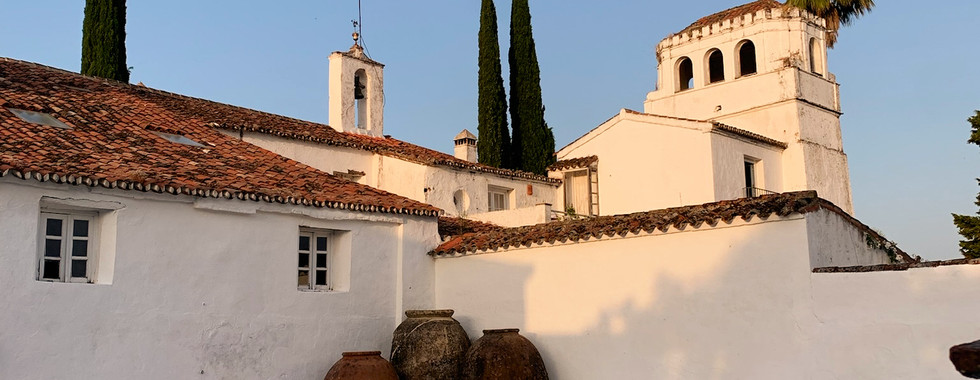
After three wonderful days in Seville we lugged out suitcases to the central train station early in the morning to collect our baby blue Renault Twingo that would take us across Andalusia to the port of Algeciras seven days later. After inspecting the toy-sized car for damage we left Seville to the north, headed for the Sierra Morena mountains and an idyllic spot in particular named Trasierra. Primarily a family home, Trasierra offers luxury bed and breakfast style accommodation across 12 double bedrooms spread throughout a lovingly restored farm complex that was once a bustling centre of wine and olive oil production. Now lost in the surrounding beauty of the green mountains, Trasierra offers a peaceful escape from modern life allowing you the time and space to truly relax and take in nature whether that be beside the pool, on the tennis court or on horseback winding through the surrounding woods.
We spent two very happy nights here absorbing the contagiously slow rhythm of Spanish life, going on walks, taking siestas and reading in the sun. For a corner of the world that both of us never knew existed prior to our trip, the Sierra Morena mountains really do pack a punch - that is, a refreshingly authentic and totally unpretentious punch.




Cordoba
After a weekend of fresh air, good food and total serenity we jumped back into the Twingo to drive two hours to Cordoba through the rolling golden cornfields of Extremadura. We had only planned to stay for one night so we had to cram in the culture (and the shopping!). First up was the infamous and vast Mezquita, an unorthodox but remarkable mosque-cathedral hybrid. It's most striking feature is that set within the two-tone double arches of the original mosque is inserted a grand baroque cathedral. The architectural union of Islam and Christianity in Cordoba reflects the harmony with which these two religions coexisted in times gone by - one that today seems sadly unattainable. After an hour in the quiet of the mosque we returned to the bustle of Cordoba's street life, wrapping the day up with an evening walk across the spectacular Roman Bridge, rooftop drinks overlooking the Mezquita and a takeaway supper.


The alarm went off early the next day to look around the Alcázar de los Reys Cristianos and its neighbouring Baños del Alcázar Califal. Both were interesting to see but we later agreed that Cordoba's striking Mezquita was a difficult act to follow. Nonetheless, Cordoba's small and picturesque centre makes it a lovely place to spend a weekend and enjoy a nice bowl of local salmorejo or two.
Via Verde del Aceite
The main objective of the day, however, was to bicycle along the Via Verde del Aceite - a disused railway through the olive oil capital of the world. We planned to bicycle 90 km from Martos, the centre of olive oil production in the region, to the hilltop town of Zuheros and back again. Due to the scorching midday heat and a slightly over ambitious itinerary this proved a challenge too far, but we did still complete a respectable 80 km. The scenery we passed along the way was quite spectacular and as far as the eye could see in all directions was a sea of olive trees - the region as a whole contains over 70 million (most of which I think we must have bicycled past!). Being a disused railway the going was fairly easy, save for the immense distance we attempted to cover, and our route contained multiple bridges that spanned beautiful olive tree lined valleys. The team at Via Bike Martos where we hired our bikes were friendly and even offered us a free upgrade to e-bikes which made the trip in 32 degree much less sweaty.


Granada
With stiff legs and a little dehydrated we hit the road again to drive to Granada - the final Islamic stronghold of Al-Andalus before it was reconquered by the Catholic monarchs Ferdinand and Isabella in 1492 (over 750 years after the Reconquista began). Of all the cities we visited in Andalusia, Granada was our favourite because of how its architecture bore the scars of years and years of Islamo-Christian rivalry. The Albaicín district for example - the medieval Moorish quarter where we stayed - is made up of beautiful narrow cobbled streets lined with white-washed houses and joined by steep staircases. The neighbourhood is filled with cafes and bars, the best of which are centred around the Mirador de San Nicolás - a popular spot for a sundowner with a view over the Alhambra and the snow-capped Sierra Nevada mountains behind.


Culturally, the Alhambra is certainly the highlight of Granada and worth booking long in advance so as not to miss out. Set high on a hill overlooking the city, the Alhambra contains a fortress, a palace, a garden and a summer retreat that once all belonged to the Nasrid dynasty of the Islamic Emirate of Granada. The views it affords back over the city are also fabulous and a ticket to the complex really is a must if you ever find yourself in the city.

El Caminito del Rey and Ronda
Our final day before crossing into Morocco was taken up by walking the incredible Caminito del Rey - 'the king's little walkway'. Not for the faint hearted, it's a wooden walkway pinned to the cliff edge and perched hundreds of feet above a precipitous drop. The scenery in the valley is wonderful and as you wind your way around the contours of the cliff edge every turn brings into view a new vista. It takes about an hour and a half to walk the 8 kms and stylish hard hats are mandatory due to the risk of falling stones. The final hurdle (if the walkway wasn't already scary enough) is a bridge suspended more than 300 feet above the roaring river below. The experience is well worth it and a great way to see the mountainous countryside and get the adrenaline pumping all at once. Plus, its only an hour from Malaga so great for a day trip.


Once we made it back to the car we drove to Ronda which only the slightest research told me was not to be missed. We picnicked in a park looking out from the cliff upon which the town is perched and then toured the monumental bull ring - one of the biggest and oldest in Spain - to learn about the history of the renowned caballeros and matadors. After this we descended to the valley floor to catch a glimpse of the much photographed 'New Bridge' of Ronda built to connect the old town with the new in 1793. After an ice cream to combat the sifling heat we promptly left Ronda for the coast to stay with Tabitha's godmother before our crossing to Morocco the next day.


Crossing the Straight of Gibraltar
After a delicious supper and a night on the beautiful Spanish coast we packed our Twingo for the final time and drove to the port at Algerciras where we returned our ride and boarded the ferry to Tangier. As we pulled out into the Bay of Gibraltar we waved goodbye to Spain (and England!) and looked forward to part two of our 1,800 mile road trip. The journey takes only an hour and a half and ferries are widely available from a number of companies who all service the route across the straight starting from around £30pp.

Morocco
Tangier
Arriving at the port of Tangier Med (instead of Tangier Ville which is serviced from Tarifa, Spain) we had an hour long taxi to reach Tangier proper. The city took us both by surprise for its level of Westernisation and subsequent familiarity. Sat on the northern tip of the African continent but looking up at the underbelly of Europe, it is no surprise that Tangier was once a writers' city inspiring creativity and freedom. Regrettably the one night that we spent there did not feel like enough to truly explore the city, but thankfully for us it is readily accessible so I'm sure we'll be back.
The following morning we collected our Kia Piccanto from downtown Tangier which, a little battered and bruised from previous use, was to accompany us all the way to Marrakech across the span of 10 days. Our first port of call was Cap Spartel 15 minutes north-west of Tangier from which you can see the Atlantic and Mediterranean oceans meeting in the jaws of the Straight of Gibraltar. It was here that we picked up straw hats each covered in pompoms which, it transpired with each passing hour we spent on the road, were worn by almost every man and woman in the countryside of Northern Morocco. From here, the tip of the African continent, we began our first long distance drive in Morocco to the blue city of Chefchaouen.

Chefchaouen
The drive was easy and uneventful, down in part to the presence of police officers on every roundabout (and there were lots) between Tangier and Tétouan. Thankfully, once we cleared Tétouan the police disappeared and we finally exceeded 60 kph as we wound our way south through the Rif Mountains.
The final 15 minutes of the drive took us high into the mountains to Chefchaouen where we parked the Kia (already renamed Kier due it and the PM's shared inefficiency and inability to support the average family!). Jokes aside though, we parked the car and once we checked in to our tiny family-run riad, began to explore the cobalt-blue lanes of the medina. Chaouen (as it is known locally) is staggeringly beautiful in a way quite unlike any other place I have ever been to... it was all, and I mean ALL, blue! Not an inch of the medina was painted anything other than a shade of blue.
As the sun set we took up our seats at a restaurant in the central square to enjoy a tagine and a plate of couscous and listen to the soothing harmonies of the call to prayer. Everyone was out to promenade and the main square with its contrasting red-walled kasbah in the middle became a meeting place for all the children to play.




Our only full day in Chaouen started with a drive out of the city after breakfast to the tiny village of Akchour deep in the Rif mountains. Known for its waterfalls and popular walking routes through the lush green valleys, Akchour's most impressive claim to geological fame is the aptly christened God's Bridge - a rock arch sitting around 100 feet above the riverbed. We arrived to find that the area near the car park was teeming with locals all enjoying a sunny Sunday but thankfully those intrepid enough to walk the 45 minutes to this natural marvel were repaid with the peace of much fewer crowds. It was the perfect spot for lunch and a great place to go swimming in the cool, but crystal clear, waters.


After a lovely morning in the Rif mountains we drove back to Chaouen, paying a visit to the roadside pottery shop on the way where we bought many intricately painted pots and plates. Far from quenching the thirst for Moroccan goods though, this roadside retail experience only bolstered the appetite for shopping from the passenger seat - all was well however becuause Moroccan shopping is both good fun and plentiful. With the precious goods secured, that evening we walked out of town to the Bouzafer mosque on the hill above the city from which we could see back over whole blue city and watch as the sun set behind the peaks. Supper was again enjoyed in the main square in a lovely restaurant called Twins, so called because there are two identical restaurants about 20 yards apart.
Volubilis Roman City
As a recently graduated classicist the Roman site of Volubilis was one of the first destinations on my list when planning our route through Morocco. Built from the 3rd century BC onwards, Volubilis came under Roman control in 33 BC and sat right on the furthest south-eastern limit of the empire. It stood amid the fertile plains of the Kingdom of Mauretania allowing it to reach at its peak a population of around 20,000 inhabitants. Today that shows in the level and quality of the ancient remains that still stand, making it a fantastic addition to any itinerary passing through Fez an hour and a half away.


We made the beautiful drive here from Chefchaouen which took about three hours meaning we arrived in the unrelenting midday heat. This was enough to put off Tabitha, a less budding antiquarian, but I pushed on (wearing my wide-brimmed pompom straw hat for protection) to look around the entire town which was fabulous.
Fez
After another hour and a half in the car we arrived in Fez - Morocco's ancient capital until it was relocated to Rabat in 1912 by the French - in the early evening and checked into the Riad Dar Cordoba. Located on the edge of the labyrinthine medina (the largest car-free urban area in the world), our riad provided a cool and quiet hideaway to escape from the heat and humdrum of the streets. Tired and hungry from a busy day, our first foray into the medina was to find something to eat. The place we stumbled across, the Restaurant Boujloud, was a little rooptop eatery rising peacefully above the din of the alleys below and perfectly positioned to hear the Maghrib - the sunset call to prayer - from all the surrounding minarets. So nice was this restaurant in fact that we returned for lunch and supper the following day to try out the rest of the menu - our theory being with restaurants, 'if it ain't broke, don't fix it'.
The following morning we enjoyed a homemade Moroccan breakfast before joining a walking tour of the medina at 10am. We were expertly guided through all the back streets by Zakaria from Guru Walks while learning about the people, architecture and social history of one of Islam's greatest centres of learning. The Al Attarine Madrasa, for example, is a 14th century school for Islamic studies with ornate tile work, while the University of Al Quaraouiyine stakes its claim as the oldest continually operating educational institution in the world dating back to as early as 859 AD - and best of all it was founded by a woman!
During the three hour tour we had made a mental map of all the shops that we were keen to revisit and after a bite of lunch returned for an afternoon of haggling. Ceramics, slippers and spices - Fez has it all and the only way to properly embrace the medina-mania is to get lost (but whatever you do don't take directions from the locals... because you'll end up in their shop with no way out). We loved our time shopping in Fez and apart from upsetting one carpet vendor with our lack of interest we encountered lots of happy people who were eager to help us and just as eager to engage in the art of haggling until, politely and fairly, a price was agree and the goods exchanged.


A day on the road
We left Fez early with a nine hour drive ahead of us. Along the way we were going to pass through many different trerrains from the fertile lands around Fez, up into the mountains of Morocco's ski resort, Ifrane, through the semi-arid region of the Middle Atlas mountains and finally dropping down into the sand dunes of the most westerly part of the Sahara desert. The journey was long but Kier did it without any complaints.
It is worth mentioning for those interested in doing a Moroccan road trip that the roads were the source of our most unexpected surprise... for they are totally empty! Outside of the cities, which admitedly are as hectic as you might imagine, the roads have very little traffic meaning we could cruise the 460 kms from Fez to the desert with ease. Stopping often for photo opportunities and for lunch which had come to mean by this point a cheese triangle and tomato sandwhich in freshly baked Moroccan khobz (or flatbread).

The Erg Chebi Dunes
At long last we arrived in the Erg Chebi dunes just north of the desert town of Merzouga. Parking the car at the Auberge Café du Sud, we then hopped aboard a string of camels to be transported to our desert camp for the night, the wonderful Sky View Camp which exceeded our expectations in every way. The tent we stayed in had a glass side that extended up to the roof which allowed for stargazing from the pillow and the sun to stream in in the morning. We were given a three course dinner with musical entertainment afterwards and after a peaceful night under pitch black, clear skies, were treated to a delicious breakfast spread. The experience was magic from start to finish.


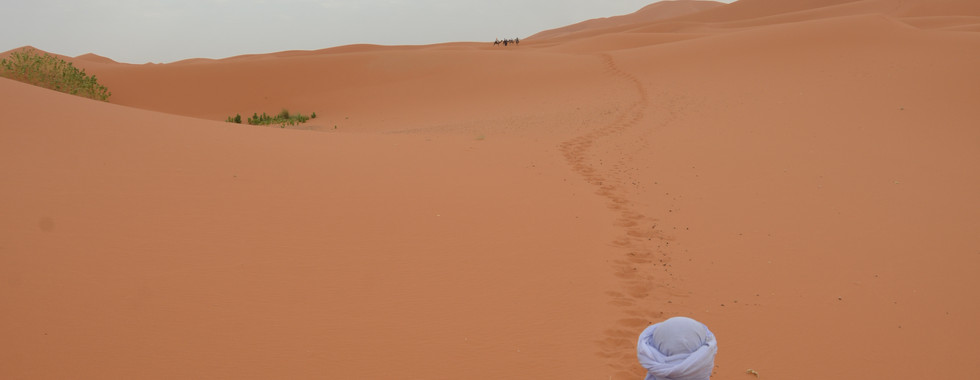


Following an unforgettable night in the desert camp we drove just 20 minutes to the Hotel Kanz Erremal sat on the edge of the dunes with a oasis-like swimming pool that seamlessly morphs into the golden sand. Found on Instagram Reels, this hotel certainly lived up to its social media stardom. We enjoyed a very happy day beside the pool reading, making the occassional foray into the dunes which sprang up from the edge of the terrace and then back into the pool to cool off. It was quite sureal to be sitting beside a pristine pool with the desert rising around us - the blues and greens of the water and palms in perfect contrast to the varying hues of golden orange sand.
Our time in the desert was extraordinary and allowed us some time to rest from what was a rather frantic and non-stop journey. The most rewarding part was that we had all the perks of a seaside resort but with none of the people - no fighting for sun loungers around the pool, no defending territory on a crammed beach, and total peace. Well done Instagram!
The Road of a Thousand Kasbahs
From the desert our next and final milestone was Marrakech, but before we made it to Morocco's most visited city we still had three nights on the famed Road of a Thousand Kasbahs. Named after the multitude of ancient fortified citadels along its route made from mud and staw, it was once a major caravan trade route and still today carries troops of travellers between Marrakech and the desert.

Our first stop on this ancient highway was the Todra Gorge. Tall, narrow and Martian red, the Todra Gorge attracts many people every day, centred around its narrowest point at just 10 metres wide. The strength of the river that once carved this mighty geological wonder is now deceptively disguised as a shallow trickle where today goats are watered and tourists bathe in its life-giving waters.

After boggling at the depth and beauty of the Todra Gorge we carried on to the next valley, the Dades Gorge where we stayed the night. The 4 star Hotel Riad Bahammou offers the perfect stay deep in the heart of the valley where you can embrace the solitude and experience some exquisite Moroccan cooking. Equally impressive as its neighbour, the stunning landscape of the Dades Gorge with its wider valley floor makes it great for those who love walking. The route we chose to explore was through the Monkey Fingers canyon which takes you up between the towering rock formations with some gaps barely big enough to squeeze through on all fours. The walk took us two hours from the main road (R704) starting at Aït Arbi, a vibrant Berber village, before we walked up the canyon and returned along the top with a view right down the valley.


Aït Benhaddou
Once we returned to the car we set off with the ancient caravan town of Aït Benhaddou in our sights, but first we stopped at a sight of more recent importance to the area - the Atlas Film Studios just outside Ouarzazate. Founded in 1983 to offer Hollywood producers year-round sunshine, the studio has hosted some major films like Kingdom of Heaven, Gladiator I and II and Game of Thrones. Following a tour of the various different film sets, ranging from Classical Greece to biblical Jerusalem and even ancient China, we continued to Aït Benhaddou.
Along the way we passed several roadside pottery shops one of which we stopped at to buy some more colourful ceramic dishes, but with our luggage allowance looming in the back of our minds we had to limit our extravagance. We continued to Aït Benhaddou which, sitting above a dry river bed, is a magnificent example of a Moroccan ksar - a fortified earthen clay village. We arrived at sunset (albeit a cloudy one) to wander through the village before settling into our kasbah hotel for the night further 'downstream' along the same dry river bed.


Taroudant
Our penultimate day on the road took us to the walled city of Taroudant our final stop before Marrakech but halfway through the 5 hour drive we stopped at the town of Tazenacht, the carpet capital of Morocco. We rolled into the town on a Sunday to find limited shops open but nonetheless we still left two hours later with three carpets in the boot.
Three hours later we pulled into Taroudant to our hotel nestled into the walls of the city. Known as 'little Marrakech' on account of these perfectly intact 5 mile long red mud walls, Taroudant offers a much more authentic vision of Morocco than Marrakech ever could nowadays. We only stayed for one night but were able to glean from our short stay its raw and down-to-earth character. There are no pretentious stays available and as such it offers all the unfiltered charm that Marrakech and Fez probably had 50 years ago.


Marrakech
Our final day in the car was easily our most challenging - and not by design. We had planned to return the car to Marrakech via the Tizi n Test pass of the High Atlas mountains to save ourselves the boredom of having to take the A3 motorway around the edge. We did not regret our decision, however it would be no lie to say we got more than we bargained for. The pass started well with paved roads winding through the mountains but before long the tarmac came to an end and what ensued was 55 miles of dirt track littered with heavy machinery repairing and recreating the route following the damage caused by the 2023 earthquake in the Al Haouz province. The suspension of our tiny Kia Piccanto rental was put to the test as was our patience but we managed to cross the High Atlas mountain range in one piece after 7 hours in the car and reaching a maximum altitude of 2,092 metres.


Following a brief stop to get the car washed at a garage, we reached Marrakech airport without any incidents and with a wealth of memories from our journey. We had covered 1,800 miles through Andalusia and Morocco, starting in the lush Sierra Morena mountains, passing through vast olive groves, crossing the Mediterranean, entering the grassy Rif mountains and Morocco's cultural capital, Fez, traversing the dry rocky plateaus, venturing into the desert, passing by the impressive gorges, and finally crossing the High Atlas mountains.
We had loved every minute of it and were sad to return the car at the end, but thankfully for us we still had three nights in Marrakech to relax and take in the final sights and sounds that Morocco had to offer us. Our original criteria were met perfectly for both shopping and culture were enjoyed in abundance along the way and it is no exaggeration to say that the roadtrip exceeded all our expectations. It has only whet our appetites to return to Andalusia and Morocco for more detailed exploration in the future.

Comments