


Seville and Instagram Tourism
- Bertie S-C

- Jul 7, 2025
- 7 min read
Updated: Aug 6, 2025
When thinking about Seville a few days before setting off on our three week road trip around Andalusia and Morocco I found myself asking: what did I actually know about the capital of Andalusia, the start of our Moorish adventure that would take us 1,800 miles from Seville to the Sahara? Other than oranges, Frank Cooper's fine cut and some patchy A-level history about the Reconquista, I concluded... not much. What I did know though was that I wanted to go and had done for some time.
I have to admit I breathed a sigh of relief when I discovered that Seville not only lived up to, but surpassed the much-elevated ideal I had in my mind. It's orange tree lined streets, golden-yellow window casings and laid-back tapas evenings in pretty plazas make it fully deserving of its popularity as a city-break destination (and well worth the £36 RyanAir ticket from London Luton).
This article aims to shed some light on how to spend a long weekend in Seville, what to see, what to skip and how to get a true flavour for the Spanish city under the sun. But first a little rant...

No doubt a result of the inexpensive flight, Seville is filled with tourists enjoying its wonderful cultural attractions and delicious culinary scene. With this mass sightseeing, though, comes a strange phenomenon which I cannot help feeling is specific to Gen Z and totally alien to those who grew up without social media... Instagram Tourism. The spectacle sees bus loads of tourists rushing around a historical site, usually of acute cultural or religious importance to the local people, with the sole purpose of capturing visually appealing content to gain social media validation. What ends up happening is that people hurry to imitate the photo that they have seen on social media, showing little to no interest in learning about the historical significance of the place they are in. Whether insensitive or just irritating for fellow tourists, this is the state of modern tourism.
What's more... it gets worse. For once positioned in prime location in front of the monument or view (which everyone else is also trying to enjoy), then the toe-curlingly cringey rigmarole of posing begins. If no complicit friend or willing member of the public is present to aid in this insanity, then out comes the selfie stick for a full blown display of unashamed pouting and self-love. Only then, after the full repertoire of pre-prepared moves has been exhausted and every angle captured sufficiently for 'the gram', the next souvenir-clad tourist can sweep in for their chance to snap exactly the same shot.
While it may be entertaining to watch, it is a shame to see so many hordes of tourists forgoing anything remotely educational and promoting a superficial photoshoot over the experience itself. They are all sheep, I tell you, afraid that if they do not get the photo to prove it, they may forget that they ever went to Seville at all! It's a load of nonsense really but it irks me to have to share by holiday with such a culturally uninquisitive bunch who are only interested in taking photos of themselves to obtain bragging rights amongst their followers.
But who am I to judge? It has not slipped my notice that, despite it being the conviction of every tourist everywhere that they are an exception, I too was a tourist in Seville and I am sure guilty of equally awful crimes.
It must also be said that the audio guides provided in Seville's Alcázar, Palacio de las Dueñas and Casa de Pilatos, were - for those seeking intellectual stimulation - exceptionally good. They were all available on your mobile meaning there was no need to pick up any special walkie-talkie and click the right number at the right time. Instead an intuitive website guided you through the monuments with insightful information, background music and even accompanying videos.
All this got me thinking. There is an awful habit nowadays of distilling such rich and varied cultures, such as is on display in Seville, into no more than a checklist of must-try cuisine, must-buy souvenirs, and must-see 'Instagram-able' locations. Tourism, I can't help feeling, has in places become a sad self-perpetuating business, sparked originally by genuine cultural appeal but diluted and distracted by snow globes and souvenirs. In the process cities have felt inclined to become stereotypes of themselves for unknowing travellers and have in doing so lost a great deal of their original charm.
All is not lost though. For today there is a school of thought that is promoting 'slow travel', one that emphasises a more mindful approach to tourism and fosters deeper cultural immersion. It aims to do away with the mass tourism offered by the likes of TUI and EasyJet package holidays in favour of promoting small businesses, local craftsmen and authentic experiences. With the continual barrage of social media however, before long these too, dare I say it, will be swamped with wannabe influencers and suffer the same over-tourism as many beautiful attractions have done before them.
With this in mind, my guide to Seville seeks to educate enquiring minds and interested travellers and not just satisfy the Instagram influencers and souvenir shoppers of this world. It takes a few days, weeks even, of living somewhere to soak up the atmosphere of the city, to understand the rhythms of life there, the circles that people move in, and thus to understand which are the tourist traps and which the genuine slices of local life. I cannot profess to know any such insight into Seville but here are some of my thoughts and suggestions as how to spend some time in the capital of Andalusia.
My Guide to Seville:
Palaces, palaces and more palaces
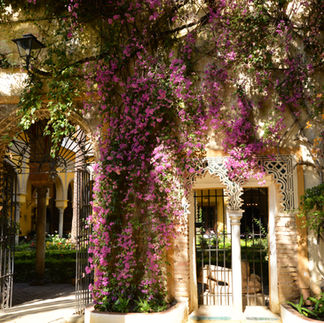
For a striking introduction to the majesty of Seville, start at the Palacio de las Dueñas. Built in the late fifteenth century with Gothic and Moorish influences it is still the private residence and home of the House of Alba, a Spanish noble family which dates back to the twelfth century. In early June the house and grounds are covered with the pink flowers of bougainvillea and the sweet scent of jasmine. The audio guide starts with a detailed tour of the gardens before taking you into the yellow courtyard which forms the centre of the palace. Radiating off the courtyard are great entertaining rooms hung with tapestries and entered through enormous carved wooden doors. The palace is cool and shaded throughout the day making it a wonderful place to come and escape the cruel heat of Seville.




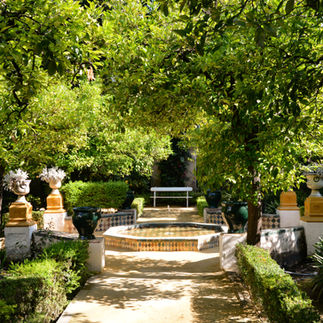
Another wonderful palace that must be on your itinerary is the Casa de Pilatos. Similar in layout to the Palacio de las Dueñas with a central courtyard and surrounding gardens, this palace also mixes Renaissance design with Mudejar influences. The principal draw, however, is the exquisite ceramic tiling (azulejos) that covers almost every surface both inside and out. In fact it is one of the largest collections of azulejos in the world and has even been used as a set location for films such as Lawrence of Arabia (1962) and Kingdom of Heaven (2005).




The final palace worth a few hours of your time is the royal palace or Alcázar of Seville. Dating back to the 10th century it was originally built as a Muslim fortress for the Umayyad Caliphate. It since became a Christian palace after Seville was conquered by Ferdinand III of Castille in 1248 and received its most major building program under Peter I in the 14th century in the Mudejar style. Today it is the oldest royal residence in Europe still in use and became a UNESCO World Heritage Site in 1987. Take some time to explore the Islamic and Christian elements of this complex and enjoy its sprawling gardens in the heart of Seville.

Seville like a local
My best advice for living like a local in Seville is to indulge in their tapas culture. To do this most authentically head to Café Santa Marta Bar in the Plaza de San Andres for supper, but remember it's Spain so don't expect to eat until 9pm when the summer heat has died down. As dusk falls the square is illuminated by its central lamp post and buskers will likely come to perform for you. For a hearty option choose the huevos rotos con jamón, a Spanish take on the British staple - ham, egg and chips.

Another great way to really experience local life in any city is to get up early before the tourists have finished their all-you-can-eat buffet breakfast and go on a run through the streets. If exercise is not for you then a walk will have a similar effect but the beauty of running is that you can cover much more distance and in Seville you can go up and down the banks of the Guadalquivir River for a beautiful (and flat) run.
Approach with caution
Perhaps one of Seville's most famous, and photographed, attractions is the Plaza de España, but I say approach with caution. Yes it is striking for its crescent shape with matching canal spanned by bridges and colourful azulejos, but don't rush there with too high hopes. Construction began in 1914 in preparation for the Ibero-American Exposition of 1929 so it has nothing like the cultural depth of some of Seville's more ancient buildings. That said, there is more to culture than just age and this plaza is a beautiful and enormous space that should be considered for a stroll.

Another potential tourist trap is the Metropol Parasol (or Las Setas - 'the mushrooms' as it is known to the locals). For what its worth there is really no need to pay to climb up to the terrace at the top, for its amazing architectural design is best admired from beneath on the street. Note also that every night at dusk it comes alive, awash with an array of different colours and beats to the rhythm of the city below.

Beyond Seville
A great site outside of Seville is the Roman city of Italica. The birthplace of the emperors Trajan and Hadrian, Italica was once a major city on the Iberian Peninsula with a population of 10,000 people. Despite its fairly modest size, the amphitheatre just outside the city walls had capacity for some 25,000 spectators which suggests its purpose as a centre for entertainment and circuses had a wider regional reach. The amphitheatre is in remarkable condition and better than the rest of the city which, although no taller than a few feet, does still house some remarkable mosaic floors. It is a must see for history buffs but I highly recommend it to all.

In sum, Seville is a city where Islam and Christianity have both carved out a shared history, one that can be seen on the face of its architecture and in the enduring legacy of its soul. Its strong Moorish influences make it alluring and mystical in equal measure, while the familiar Christian elements add a sense of European charm. There is nothing not to love, it's warm, leafy, full of fabulous cultural attractions and fuelled by tapas. So what are you waiting for, get on and book that £36 flight!


Comments